
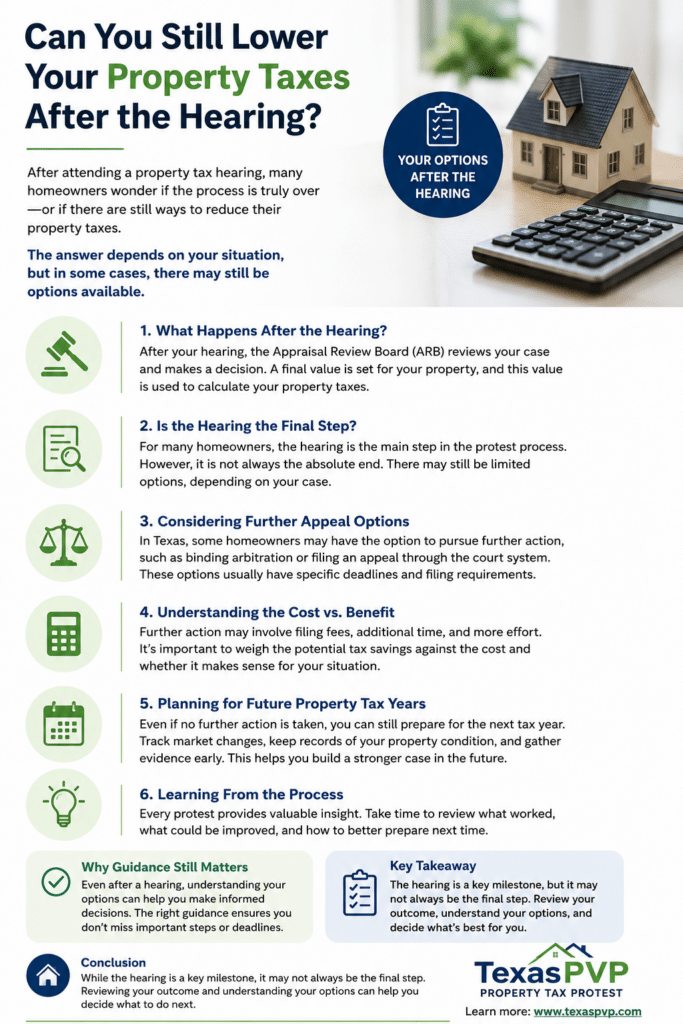
After attending a property tax hearing, many homeowners start to wonder:
Is the process really over? Or is there still something I can do?
The answer depends on your situation.
In some cases, there may still be options available after property tax hearing Texas proceedings wrap up.
What Happens After the Hearing?
Once your hearing is completed, the Appraisal Review Board (ARB) reviews your case, which is a procedure you must be aware of after a property tax hearing in Texas.
After that, a final value is determined for your property.
This value is then used to calculate your property taxes.
Is the Hearing Always the Final Step?
For many homeowners, the hearing is the main stage of the process that occurs after a property tax hearing has taken place in Texas.
However, it is not always the absolute end.
In certain situations, there may still be limited options to consider.
Reviewing Your Outcome
At this point, it is important to carefully review your result after your property tax hearing in Texas.
Ask yourself:
- Does the final value reflect the evidence you presented?
- Were your key points clearly addressed?
This step helps you understand where you stand.
Looking at Further Options
In Texas, some homeowners may choose to take things a step further after property tax hearing options are presented.
For example, you might consider:
- Binding arbitration
- Filing an appeal through the court system
However, these options come with deadlines.
They also require proper documentation.
Weighing the Cost and Benefit
Before moving forward, take a moment to think it through. Keep in mind, evaluating your decisions after the property tax hearing process in Texas is crucial for the best outcome.
Further action may involve:
- Filing fees
- Additional time
- More effort
Because of this, it’s important to compare the potential savings with the cost involved.
Planning Ahead for Future Years
Even if you decide not to continue, this is not the end of the road. In Texas, learning from what happens after your property tax hearing can help next year.
You can still prepare for the next property tax cycle.
For instance:
- Track changes in your local market
- Keep records of your property’s condition
- Gather useful evidence early
This can make a big difference next time.
Learning From the Process
Every protest provides insight into how to handle the period after a property tax hearing in Texas in the future.
Take note of what worked well.
Also, identify areas that could be improved.
Over time, this helps you build a stronger approach.
Conclusion
The hearing is an important milestone for Texas property owners. Navigating your choices after the property tax hearing can impact your results.
However, it may not always be the final step.
By reviewing your outcome and understanding your options, you can make a more informed decision about what to do next.